English
 عربي
عربي
 Malay
Malay
 ภาษาไทย
 Tiếng Việt



Aluminum single-panel panels and multi-perforated aesthetics: From industrial precision to artistic display in commercial spaces
In modern architectural design, aluminum panels are widely used for facade decoration, their lightweight properties giving buildings a more modern and technological feel. Through clever combinations and designs, aluminum panels can create rich and unique decorative effects, endowing buildings with a distinctive personality and charm. And when a CNC punch press creates the first precise hole in an aluminum panel, from the purity of a single hole to the rhythm of multiple holes, this art form born from industrial precision is redefining the visual boundaries and sensory experience of commercial spaces.

I. Technological Breakthrough: When Standardized Production Meets Parametric Design
The core of modern multi-perforation technology for aluminum panels lies in the integration of precision manufacturing and creative design. The DIXXIN Chinese factory utilizes a production process combining CNC turret punching machines and laser cutting to achieve personalized expression from standardized production.
Breakthroughs in technology have elevated perforated aluminum sheets beyond simple functional components. Modern waterjet cutting and laser punching technologies enable hole diameters ranging from 0.5mm to 100mm, expanding hole shapes from traditional circles to squares, rhombuses, hexagons, and even custom patterns. Surface treatments such as anodizing, fluorocarbon coating, and wood grain transfer further enrich their color and texture. This perfect combination of industrial production and artistic expression makes each perforated sheet a mass-producible 'custom-made work of art.'
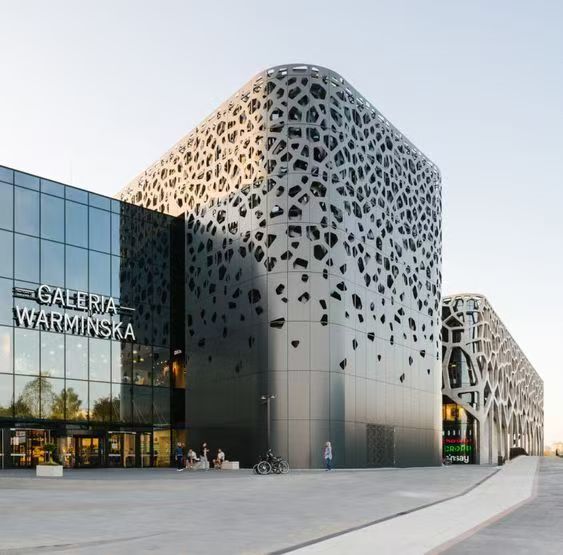
II. Design Language: An Aesthetic Lineage from the Purity of a Single Hole to the Rhythmic Flow of Multiple Holes
The allure of single-perforation design lies in its minimalist purity.
A regular array of circular perforations creates a stable visual rhythm, suitable for commercial spaces requiring a subtle background. Multi-perforation designs, on the other hand, offer a stronger visual impact. By combining and arranging perforations of different sizes, designers can simulate natural textures—such as gradually spreading water ripples, randomly distributed star patterns, or organically growing leaf veins. The gradient perforation, transitioning from dense to sparse, creates a unique visual guide on the facade, naturally directing foot traffic to key areas within the commercial space.
III. Commercial Applications: The Value Integration of Functional Aesthetics in Spatial Scenarios
In commercial space design, The DIXXIN aluminum panels transforms them from decorative elements into functional components. Large perforated screens in shopping mall atriums serve as visual focal points for brands, maintaining visual transparency while naturally guiding foot traffic to anchor stores. Perforated partitions in office spaces ensure light transmission while effectively reducing noise transmission; custom-patterned perforated panels on restaurant ceilings transform brand cultural symbols into a tangible spatial experience.
Sustainability has become a new dimension in the commercial application of perforated aluminum panels. The perforated design of the facade effectively reduces the building's heat load, forming a highly efficient climate-adaptive skin when combined with backing insulation materials.
Perforated sound-absorbing panels used indoors significantly improve the acoustic environment, enhancing the comfort and willingness to linger in commercial spaces. More importantly, these aluminum panels are fully recyclable at the end of their life cycle, aligning with the circular economy concept and adding an environmentally friendly dimension to the value proposition of commercial brands.

Underwent a transformation from raw material to design medium. Through deliberate proportional studies between perforated areas and solid surfaces, designers are creating new dialogues about presence and perception in commercial environments—where selective material subtraction becomes a powerful vehicle for spatial expression.